Flared Jeans Explained: A UK Buyer's Guide
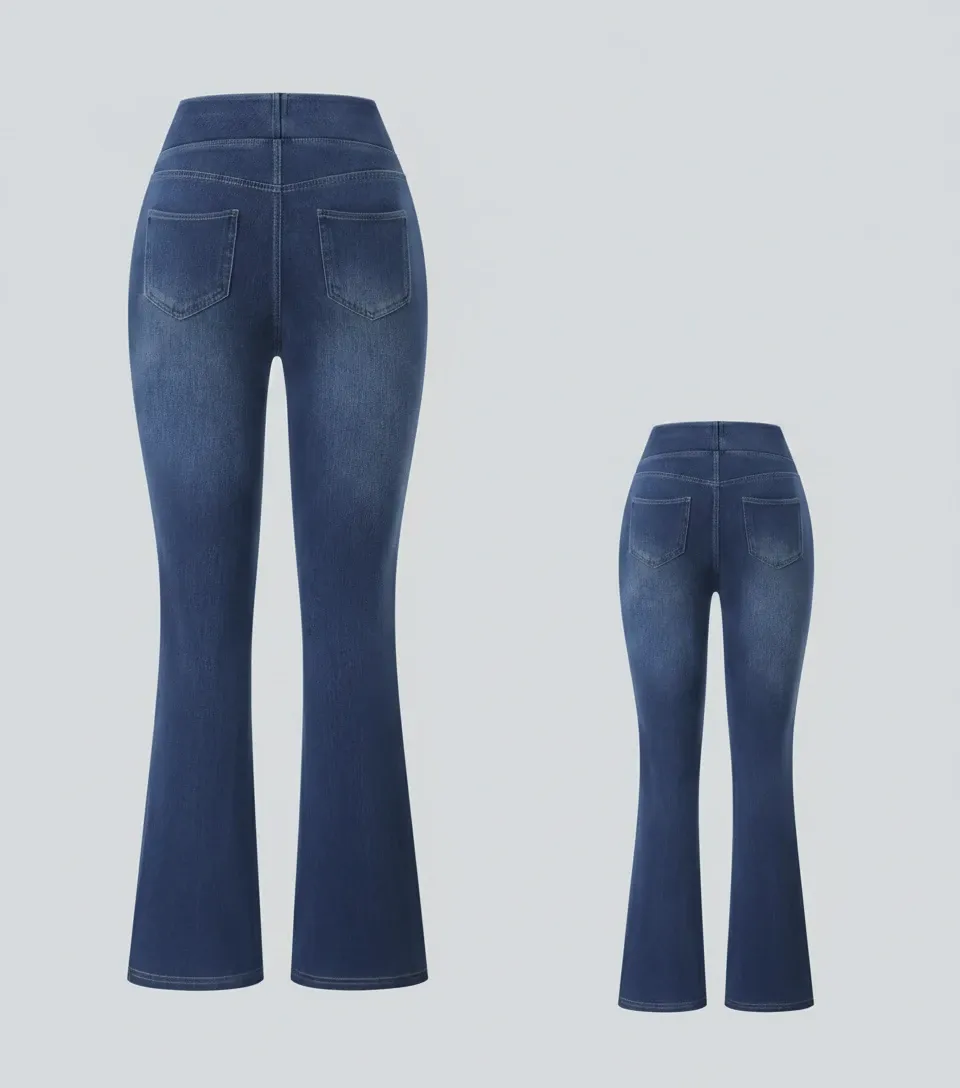
Flared jeans are jeans that fit closely through the hips and thighs, then widen from the knee down into a noticeably wider hem. They flatter most figures by balancing proportions and lengthening the leg line — but only when the length is right for your height and shoes.
TL;DR: Flared jeans are worth buying if you want a leg-lengthening shape that works with boots, heels and chunkier trainers. If you are petite, treat the inseam figure as the single most important line on the product page: know your own inseam in inches, compare it against the listed measurement, and plan any shortening carefully so the flare keeps its proportion.
This guide explains what flared jeans are, how they differ from bootcut styles, where a standard 31-inch inseam actually falls if you are 5 ft 2, and how to shorten a flare without ruining it. Once the fit is sorted, our guide on how to style bootcut jeans covers outfits that work for the gentler version of this silhouette.
What should you know before buying flared jeans?
- The silhouette: Fitted through hip and thigh, widening from the knee down. The flare should start at or slightly above your actual knee — a flare cut for a taller frame can break too low on a petite leg.
- Check the inseam, not the model: Product photos are usually shot on models around 5 ft 8. The inseam measurement in inches tells you far more about where that hem will land on you.
- Shortening has limits: Taking up around an inch keeps the flare intact; go much beyond two inches and the hem circumference visibly narrows.
- UK practicality: With your usual shoes on, the hem should hover just off the ground. A dragging flare soaks up rain and grime on wet pavements within a week.
What are flared jeans?
Flared jeans are denim trousers cut close through the hip and thigh before widening noticeably from around the knee to the hem. That contrast — fitted on top, fuller below — is what draws the eye downward and makes legs look longer.
Unlike straight-leg jeans, which keep a similar width all the way down, flares create a deliberate bell shape. The strength of that bell varies: a subtle kick reads modern and easy, while a wide 1970s-style bell makes more of a statement and demands more length to look right.
How does the knee-to-hem shape define flared jeans?
The key detail is the difference between the width at the knee and the width at the hem. True flares expand visibly below the knee rather than only easing out at the ankle. For petite shoppers this matters twice over: the wider the hem, the more any excess length crumples on your shoe — and the more obvious a poorly judged alteration becomes.
What is the difference between flared jeans and bootcut jeans?
The main difference is how much the leg widens below the knee. Bootcut jeans widen slightly — originally just enough to sit over boots — while flared jeans widen much more, so they make a stronger style statement.
In practice, bootcut styles are more forgiving on length: a slightly-too-long bootcut still hangs cleanly, while a slightly-too-long flare collapses on the shoe. If you are between the two looks and under about 5 ft 4, a bootcut such as the one covered in our high waisted bootcut jeans guide is the lower-risk buy. For roomier silhouettes cut wide from the hip, see our wide leg jeans guide instead.
How should flared jeans fit?
Flared jeans should feel secure at the waist, smooth through the hips and thighs, and fall into the flare without pulling at the knees or twisting at the hem. The top half should look fitted rather than tight; the drama belongs below the knee.
Where should the flare start on a petite frame?
On a 5 ft 0 to 5 ft 3 frame, check where the leg actually begins to widen when you try them on. If the break sits below your kneecap, the flare will visually shorten your leg instead of lengthening it. A higher rise helps here too: it moves the visual waistline up and gives the flare more leg to work with.
Should flared jeans be tight on your thighs?
They should skim closely without strain. Horizontal pulling across the front of the thigh or pocket area means the cut is too tight; excess looseness in the upper leg blurs the contrast that makes a flare work. Stretch denim with good recovery holds that line through the day instead of bagging by lunchtime.
Where will a 31-inch inseam actually fall if you're petite?
Most regular-length flared and bootcut jeans in the UK — including our own Everyday Pull-On Bootcut Jeans — come with a 31-inch (78.7 cm) inseam, designed to suit heights of roughly 5 ft 4 to 5 ft 7 with a trainer or small heeled boot.
If you are 5 ft 2, expect surplus length with flat shoes. How much depends on your leg-to-torso ratio: one verified buyer at 5 ft 2 had our pair taken up by about an inch to wear with flat trainers, while shorter-legged frames may need two inches or more. Before you book a tailor, do a simple test at home: put on the shoes you will genuinely wear most, stand on a hard floor, and fold the hem under until it hovers just off the ground. Pin it, walk around, and measure what you folded.
Two practical rules follow. First, test with both a flat shoe and your most-worn heel — a hem set for block heels will pool over trainers. Second, do all of this before any alteration: jeans you have had shortened can no longer go back, while an unaltered pair stays inside a 30-day returns window if the fit is wrong elsewhere.
Can flared jeans be shortened without losing the flare?
Yes — within limits. Because the leg widens gradually from the knee, removing around an inch from the hem barely changes the width. Removing two inches or more starts to cut into the widest part of the bell, so the finished hem is visibly narrower and the flare loses some of its swing.
To keep the proportion: ask the tailor to take the jeans up from the hem using the original-hem technique (sometimes called a “tricky hem”), which reattaches the factory finish; and ask them to preserve the hem width rather than tapering as they go. A straightforward shortening at a UK tailor or dry cleaner typically costs around £10 to £20, with original-hem finishes at the upper end or a little above — worth adding to the price when you compare pairs, but far cheaper than a pair that never gets worn.
An honest note: if you never wear heels, dislike paying for alterations and want a hem that works straight out of the packet, a petite-specific range or a subtler bootcut will serve you better than a dramatic flare. Our own pair comes in the single 31-inch regular length — petite buyers should budget for that small alteration.
What should you look for when buying flared jeans in the UK?
1. Which rise works best for flared jeans?
A high rise anchors the flare visually and suits petite frames by raising the waistline. The catch with traditional high-rise denim is hardware: a rigid button waistband can dig when you sit. Our flared-family styles use a pull-on, tummy-smoothing V-crossover waistband instead, so you get the anchoring effect without the dig — and no button bump under tucked-in tops.
2. What fabric is best for comfortable flared jeans?
Check the fibre content before anything else. A cotton-rich blend with a small amount of elastane — ours is 75% BCI cotton, 23% polyester and 2% elastane — gives authentic denim character with four-way stretch and, crucially, recovery: the fabric returns to shape after sitting instead of developing baggy knees.
3. How long should flared jeans be in UK weather?
Britain is rainy and pavements stay damp for much of the year. A flare that touches the ground will wick up water and fray quickly, and dark washes show tide marks. Set the hem to hover just above the ground with your everyday shoes — and if in doubt between two lengths after alteration, go for the marginally shorter one.
Frequently asked questions
Are flared jeans a good choice for petite women?
Yes, provided the flare breaks at or above your knee and the hem is set for your usual shoes. A well-fitted flare with a high rise is one of the most leg-lengthening cuts a petite frame can wear; a too-long flare does the opposite.
How much does it cost to shorten flared jeans in the UK?
Typically £10 to £20 at a local tailor or dry cleaner for a standard shortening; keeping the original hem finish usually costs a little more. Ask for the hem width to be preserved so the flare proportion survives the alteration.
Should I shorten flared jeans before deciding whether to keep them?
No. Wear them indoors with your most-used flat shoes and your most-used heels first, and check the waist and hip fit after a full evening of sitting and moving. Alterations are permanent, and an altered pair can no longer be returned — do them only once you are certain everything else fits.
What shoes work best with flared jeans at 5 ft 2?
A small block heel, heeled ankle boot or platform-sole trainer keeps the hem moving cleanly and buys you leg length. Completely flat, thin-soled shoes demand a shorter hem — which is exactly when careful alteration matters most.
Do flared jeans come in petite lengths?
Some high-street ranges offer petite cuts; many online styles — including our Everyday Pull-On Bootcut Jeans — come in one regular length (31-inch inseam). If a pair you love only comes in regular, plan for roughly an inch or more off at the tailor rather than ruling it out.
Ready to experience pull-on comfort with a flattering flare?
Free UK delivery on orders over £50 · 30-day hassle-free returns · 12-month warranty
Shop Pull-On Bootcut Jeans — £38.95